







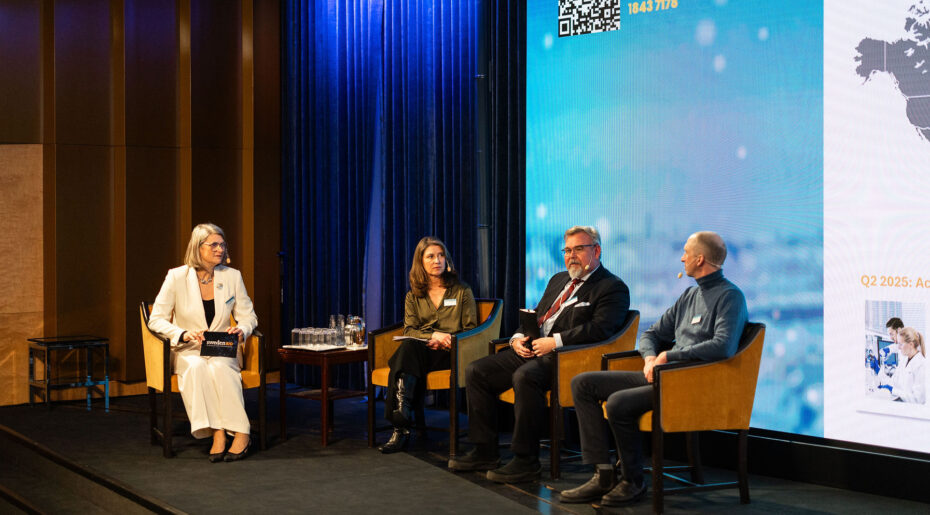
What is needed for Sweden to maintain and strengthen its position as a strong life science nation, and how can more companies grow here? This was the focus of one of the panels at this year’s Summit, under the heading: How to Build and Scale in Sweden?
The session highlighted Sweden’s unique advantages, the challenges faced by the sector, and strategic choices needed to foster growth.
Åsa Rosenlund Manelius, Managing Director/ VP, Novavax, Klaus Langhoff-Roos, CEO, BioLamina and Patrik Ling, VP Investor Relations Scandinavia, Alvotech shared their perspectives on stage at Grand Hotel in Stockholm.
Åsa Rosenlund Manelius opened the discussion by emphasizing Sweden’s reputation for a highly skilled workforce and a strong commitment to academia. She remarked, “Sweden is viewed as a country with a highly skilled and talented workforce and a strong respect for academia.” Nonetheless, Åsa raised concerns about the future availability of talent, suggesting that continuous investment in R&D and manufacturing is essential. She noted that maintaining close interactions between manufacturing and scientific experts is critical for success, particularly in complex technology sectors.
Klaus Langhoff-Roos echoed Åsa’s sentiments regarding Sweden’s competitive advantages. He stated, “Sweden offers a highly skilled workforce at a substantially lower cost than many neighboring countries.” Klaus stressed the need for entrepreneurship, drawing attention to the role of life science incubators and accelerators in bridging science and business. He identified three essential ingredients for scaling biotech companies: strong scientific foundations, the ability to scale with experienced talent, and a global mindset from day one.
Patrik Ling spoke about the strategic advantages of establishing a presence in Sweden. He noted, “Sweden has one of the strongest life science investor bases in Europe,” which facilitates easier funding and operational growth for companies like Alvotech. He highlighted the company’s recent expansion into Sweden, underscoring the potential for the region to become a robust R&D hub.
Jessica Martinsson, CEO of SwedenBIO, moderated the panel discussion, guiding the conversation towards the pressing issues of regulatory speed and attracting international talent. Åsa pointed out, “One of the main challenges is speed, particularly in the regulatory and permitting processes,” calling for a more efficient system to support companies looking to scale quickly. Both Klaus and Patrik agreed, emphasizing that slow permitting can discourage investment and slow down innovation.
The panelists also discussed the importance of collaboration with academia, with Åsa stating that “Sweden does very well in collaboration, especially access to academia.” This ease of partnering with universities provides a competitive edge, particularly for smaller companies that may lack all capabilities in-house.
In closing, the discussion turned to the future of Sweden’s life science sector. Klaus highlighted the necessity of strategic choices given Sweden’s small size, suggesting that the country should focus on being a significant player in specialized areas rather than spreading itself too thin. He posited that Sweden could excel in supporting cell therapies, which would require data-driven decisions and a commitment to niche markets.
The session underscored the need for a collaborative approach between industry stakeholders and policymakers to enhance Sweden’s attractiveness as a global life science hub. The panelists collectively recognized the potential of innovative R&D tax incentives to support both profitable and non-profitable companies, which is critical for sustaining long-term growth and competitiveness in the life sciences sector.
