







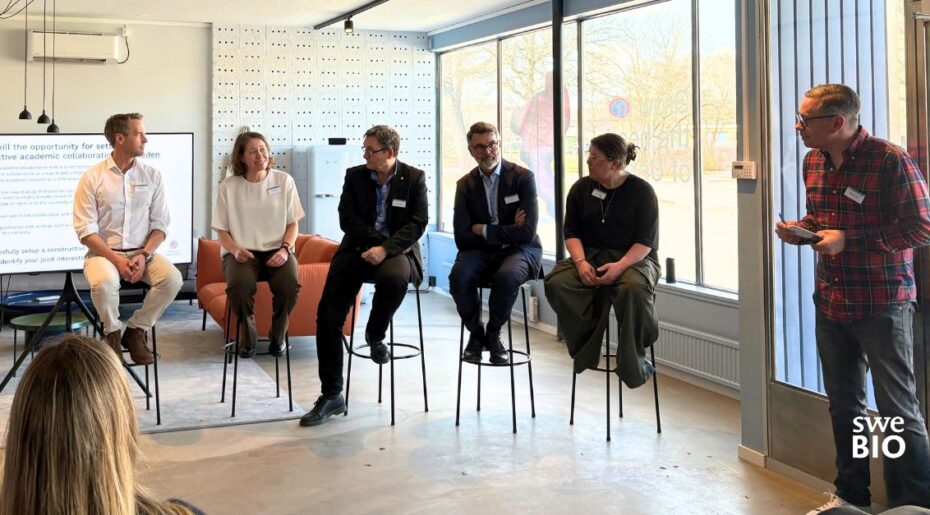
Organized by SwedenBIOs IP working group, the event focused on intellectual property (IP), legal frameworks, and the practical realities of collaboration. Speakers included Johanna Bergh, AWA, Per Hedman, Cirio advokatbyrå, Henrik Ihre, Cytiva, Sara Mangsbo and Andy Browning from Uppsala University and moderated by Magnus Lejelöv from STUNS.
Johanna Bergh opened by emphasizing the centrality of IP: “Intellectual property (IP) typically represent a significant portion of a life science company’s value”. She explained the distinction between ”background IP” (what each party brings) and ”foreground IP” (results generated), stressing that companies must secure access and control to attract investment and enable commercialization. She also highlighted the Swedish “teacher’s exemption,” where researchers–not universities–own their results, complicating agreements.
Per Hedman provided a legal lens, focusing on NDAs and MTAs: “Much of the information sharing industry depends on NDAs.” He stressed that the approach to NDAs must be tailored–“it’s not a one-size-fits-all approach-” and warned that failure to duly handle of confidential information can derail major deals. He also underscored GDPR and compliance risks, noting that non-compliant data can seriously disrupt projects.
From the university side, Andy Browning clarified structural realities: “The most important question is whether you are truly collaborating.” He distinguished ”collaboration” from ”commissioned research”, noting that in true collaborations, “results are typically owned by the party that generates them,” often individual researchers. He cautioned that term sheets assuming institutional IP ownership may fail in Sweden.
Henrik Ihre from Cytiva brought an industry perspective grounded in innovation and impact..” He warned that while companies excel at incremental improvements, “we don’t have the best solutions in place” for emerging therapies. A key concern was limited collaboration: “there’s often a ‘not invented here’ mindset… but that’s not the way forward.” He believes that stronger collaboration with academia is crucial for the future.
Sara Mangsbo offered a dual academic–industry view, focusing on incentives and practical experience. She explained that academic careers depend on more than research: “you have to show that you meet a certain level in each step.” She highlighted both successes and failures in collaborations, noting: “we didn’t get any data for publications… it was only run by the industry party,” illustrating how poorly structured agreements can undermine academic value. Her advice was clear: “don’t try to run academic researchers as a CRO”.
The need to understand the purpose of the collaboration, align expectations early, clearly define ownership of IP and data rights, and distinguish between collaboration and commissioned research were key perspectives that emerged during the seminar. Effective partnerships depend on mutual understanding and complementary strengths. As one speaker summarized, “if you don’t have that common ground… don’t even continue.”
