







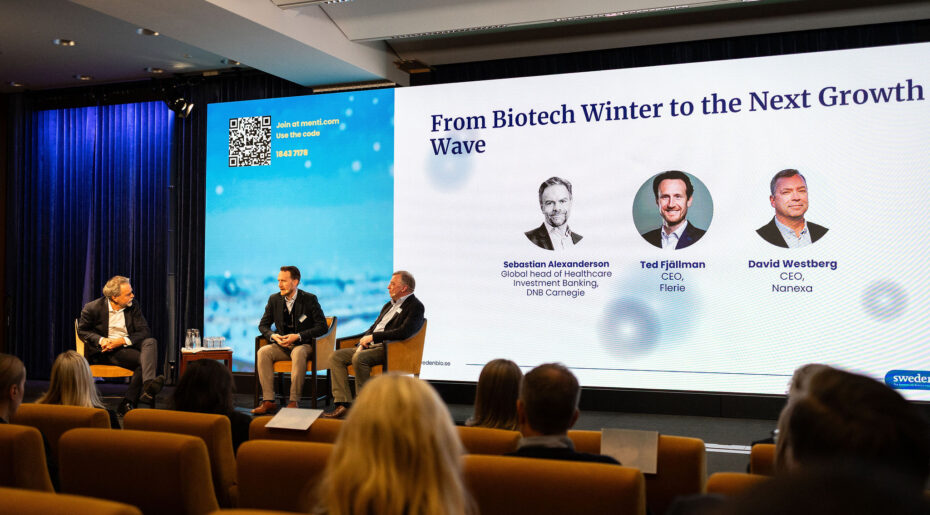
After several years of tight capital markets, compressed valuations, and hesitant public investors, the global life science sector is still feeling the effects of the “biotech winter.” The discussion is shifting however. How can Swedish biotech companies navigate the later stages of the downturn, and position themselves for long-term growth toward 2030?
Sebastian Alexanderson, Global Head of Healthcare Investment Banking, DNB Carnegie, Ted Fjällman, CEO, Flerie and David Westberg, CEO, Nanexa shared their perspectives on stage.
Early signs of recovery
Opening the panel, Sebastian Alexanderson reflected on the overall mood at JPMorgan Healthcare Week in San Francisco. While the sector is far from euphoric, there is a growing sense that conditions are improving after a prolonged and difficult period: “I think many of us came away feeling cautiously optimistic, or at least sensing that change is underway,” Alexanderson said. “Gradually, we’re seeing promising signs that the life science sector is recovering from what has been a very tough few years.”
He pointed to falling interest rates as a key driver behind renewed investor appetite for biotech, allowing capital to rotate back into risk assets. M&A activity has also accelerated significantly, particularly in the second half of last year, as pharmaceutical companies look to deploy capital and secure future pipelines: “Pharma companies are ready to deploy capital, and competition for assets is increasing,” he noted. “At the same time, innovation trends remain strong, with solid clinical data and expectations for a very data-rich year ahead.”
Alexanderson also highlighted the structural importance of the Nordic capital markets, particularly Sweden, for the European life science ecosystem: “Roughly half of Europe’s IPO activity now takes place in the Nordics, most of it in Stockholm,” he said. “That’s a very important asset, and we hope it will support a return of biotech IPOs over time.”
While access to US capital remains essential, the strength of Nordic public markets provides a critical foundation for growth companies, especially during periods when global markets are volatile. “Access to capital is often underestimated in terms of how important it really is for company growth,” Alexanderson added.
Fewer companies — but stronger survivors
From an investor perspective, Ted Fjällman described how the downturn has reshaped the Swedish biotech landscape. While the number of active companies has declined, the overall quality of those that remain has improved: “Sweden has gone from around 55 to 37 well-capitalised biotech companies in a relatively short period,” Fjällman said. “That sounds negative, but what it really shows is resilience. What remains is higher quality.”
Fjällman, whose firm manages 25 portfolio companies, argued that the sector may now be approaching a transition point, from years of intensive investment to a phase where value creation and exits become more realistic: “We’ve been investing, investing, investing for several years,” he said. “What I’m hoping we’re entering now is a period where it may soon be time to start selling, at least in Europe.”
He also noted that European biotech valuations remain attractive compared to the US, where domestic companies are trading at a premium: “US investors are increasingly looking to Europe,” Fjällman said. “They’re paying high prices at home, and Europe is starting to look very interesting by comparison.”
Strategic focus in a constrained funding environment
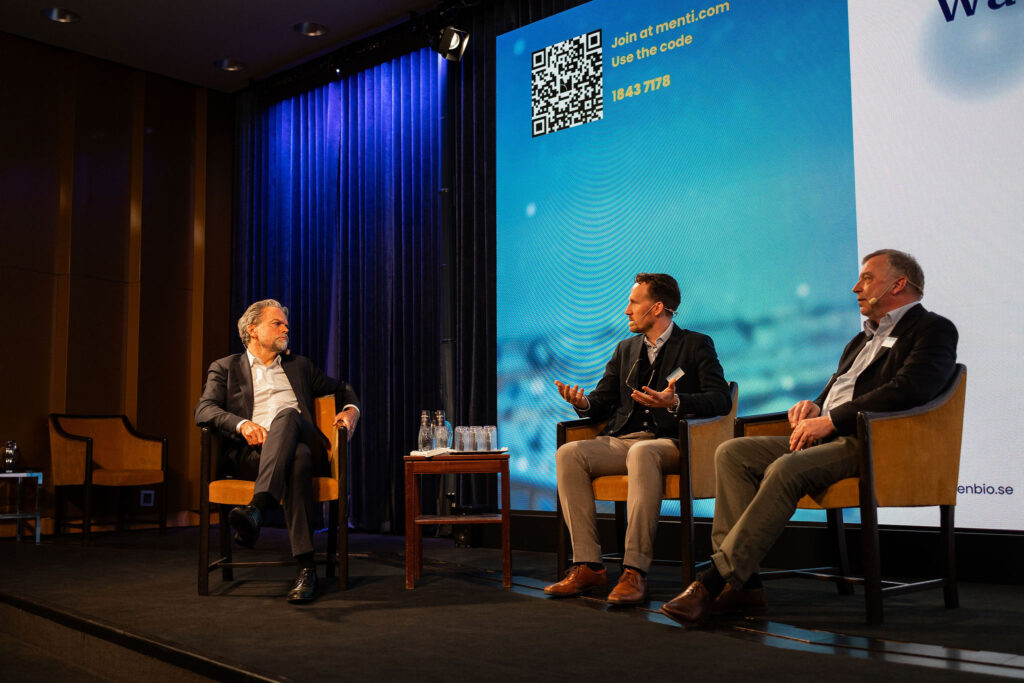
Representing the company perspective, David Westberg shared how Nanexa adapted its strategy during the financial downturn. With limited access to capital and a modest market valuation, the company made a deliberate choice to narrow its focus and prioritise partnering over internal expansion: “Given the financial climate in Sweden, we realised we couldn’t fund large internal programmes,” Westberg said. “So we shut down some projects and focused on feasibility studies with big pharma, those most likely to lead to licensing deals.”
That strategy led to a major licensing agreement with Moderna at the end of last year, centred on Nanexa’s long-acting drug delivery technology: “The Moderna deal is a direct result of that focus,” Westberg said. “Going forward, our priority is to generate revenue through licensing rather than relying solely on equity financing.”
He also highlighted the potential of long-acting formulations in large therapeutic areas such as GLP-1 therapies: “This is a massive market,” he said. “Improving formulations here has the potential to make a real difference for patients worldwide.”
Europe, the US, and global capital flows
The panel also addressed broader policy and funding questions, including drug pricing dynamics and fundraising conditions for Nordic venture funds.
On US pricing pressure and the so-called Most-Favored Nation policy, Fjällman emphasised that the US market remains indispensable for biotech companies: “You wouldn’t make an investment without a credible US business case,” he said. “It would be unwise to disregard the US entirely, even if pricing models may change over time.”
At the same time, he suggested that Europe may eventually need to accept higher drug prices to sustain innovation: “Europe has not pulled its weight when it comes to funding pharmaceutical innovation,” Fjällman said. “Some correction is probably necessary.”
Attracting international investors starts at home
Finally, the discussion turned to how Swedish biotech companies can attract US or Asian venture capital. The message was clear: international interest starts with local credibility: “If you go to the US without a European lead investor, the first question will always be: ‘Why hasn’t Europe invested?’” Fjällman said. “So secure a strong European lead first, then expand internationally.”
He also encouraged Swedish companies to be more proactive internationally. “We’re not always bold enough when it comes to building relationships outside Sweden,” he said. “But you have to travel, meet investors, take direct feedback, and learn from it.”
Despite ongoing challenges, from geopolitical uncertainty to funding pressures, the panel concluded that the overall direction for life sciences is improving: “The glass isn’t full,” Alexanderson concluded, “but it’s clearly half full. We’re entering a year with a more robust and constructive environment for life sciences than we’ve seen in some time.”
While the biotech winter may not be fully over, the discussion made clear that its later stages are producing a more focused, resilient, and globally competitive Swedish biotech sector.
