







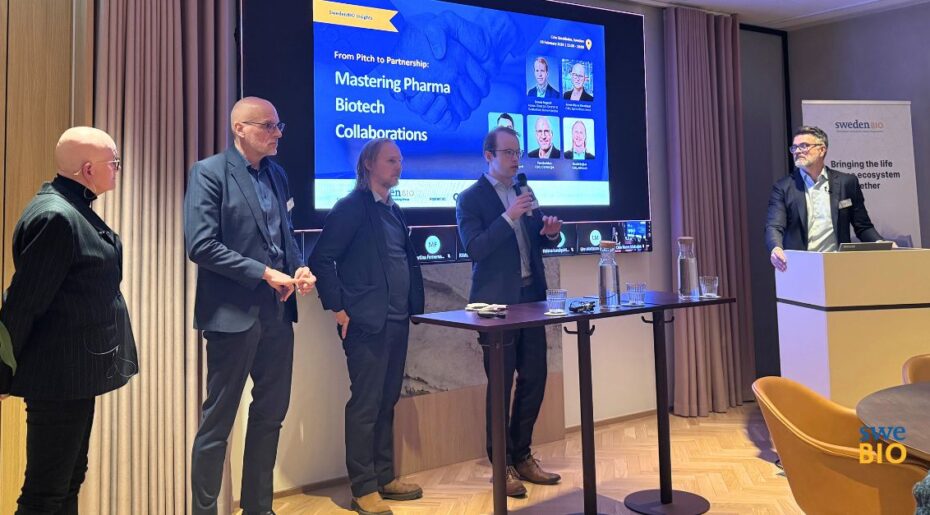
The well-attended seminar, held on 3 February at SwedenBIO member Cirio law firm in Stockholm, saw four experienced industry leaders share practical insights from real-world collaborations.
The Pharma Perspective: Strategy and the Funnel
For big pharma, external innovation is a necessity, not an option. Simon Regnéll, Associate Director at Novo Nordisk, emphasized that every partnership must align with a long-term strategy designed to serve patients decades into the future. Using a recent triple-agonist deal with United Biotechnologies as a case study, Regnéll illustrated the intensity of the “funnel.”
The process often involves technical due diligence where upwards of 100 specialists review everything from raw clinical data to CRO contracts. “Data matters more than market size explanations,” Regnéll noted, advising biotechs to focus on differentiation rather than broad projections: “In this context, a ‘no’ is never really a no. If you come back with something new to share, we are generally open to taking another look.”
Navigating the “Headache”: Real-World Transaction Dynamics
Ton Berkien, CBO of Cantargia, shared a candid look at their asset deal with Otsuka. He highlighted that unlike licensing, asset deals resemble M&A and involve complex hurdles like regulatory approvals and tax jurisdictions. In a cooling venture market, Berkien argued that strategic deals are a vital alternative to equity financing.
Success, according to Berkien, requires “doing your homework” on a partner’s culture. Navigating the internal dynamics of a Japanese organization like Otsuka required deep empathy and “deal currency”, the trust built through transparent, data-driven communication: ”BD does not always fully understand what R&D truly wants, so make sure those connections exist… build bridges directly with R&D”, he recommended.
The “3D” Framework of Alliance Management
David Bejker, CEO of Affibody, reframed alliance management as a function as critical as investor relations. He introduced his “3D Framework” – Deals, Data, and Dough –noting that these three elements form a virtuous circle that drives a pre-commercial biotech.
Bejker argued that biotechs must be proactive in defining their role within a partnership. If you are a Phase III powerhouse, you should be on the pricing committee; if you are a chemistry shop, lead on IP. He also stressed the importance of “daring to be difficult” by insisting on formalities like signed minutes and strict governance: “Often, your counterpart won’t know the agreement as well as you do… That means you’re often the adult in the room.”
The “Prenuptial” and the Power of Repositioning
Anne-Marie Wenthzel-Buckhöj, CBO of Sprint Bioscience, compared a partnership to a marriage where the contract is merely the wedding ceremony. The real work lies in understanding a partner’s true drivers. She emphasized that a “prenuptial agreement” –clear termination terms – is a sign of corporate maturity, not pessimism.
When an asset is returned, as happened with Sprint’s MASH program from LG Chem, it should be viewed as a strategic inflection point rather than a failure. By analyzing why the asset came back and looking at the data with fresh eyes, Sprint successfully repositioned a metabolic program into a high-quality inflammation asset.
“The return is not the end, but the end of the beginning… What looked like a setback became the beginning of a new opportunity”, she explained.
Key Takeaways:
- Prepare for the Workload: Due diligence can involve hundreds of people; ensure your R&D team is in “selling mode” and your data room is pristine.
- Alignment is Key: Use your Business Development contacts to navigate the many approval layers within large pharma.
- Live the Contract: Treat alliance management as a formal discipline to ensure what is learned in a partnership is reused internally.
- Master the Pivot: If a program is returned, evaluate the competitive landscape and reposition the narrative based on the data’s core strengths.
