







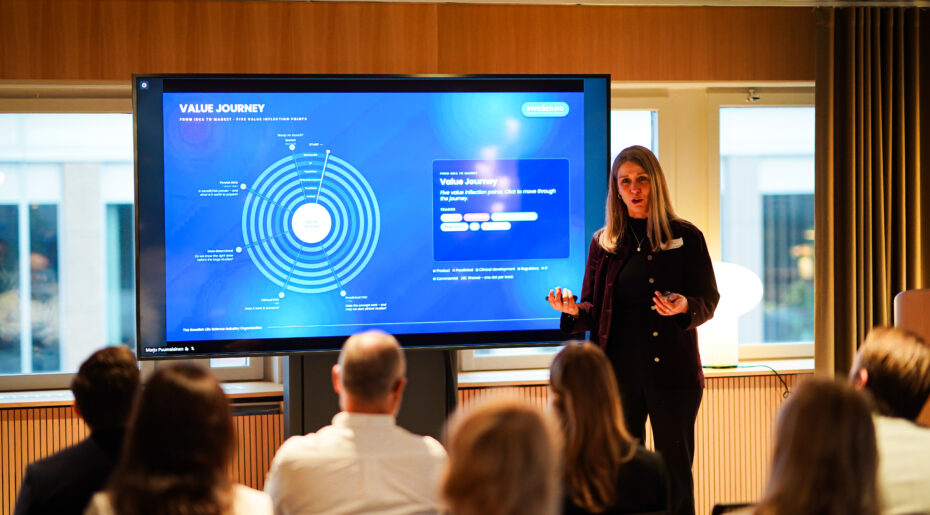
The seminar was organized by SwedenBIO’s Business Strategy group. Åsa Magnusson of Regsmart Life Science opened by presenting the group’s model of the biotech value journey, from idea to market. It is built around five value inflection points where investors are ready to invest, with a commercial track running in parallel throughout.
“The commercial thinking needs to be there from the start and not only at the end stage,” Magnusson said. “Why do we even use that word? It’s not an end stage. It’s actually the beginning of everything – the launch.”
She stressed that companies can begin consider payers’ perspective far earlier than many assume, long before the pivotal phase 3 trials, when market access experts are usually called in. “This is actually possible to do. Investors are as interested as you are in how payers will value your asset,” she said. She added that if the groundwork has been done, “the payer data will be quite straightforward. You need to predict what your asset will be compared with – from a payer perspective.”
“You can predict the future”
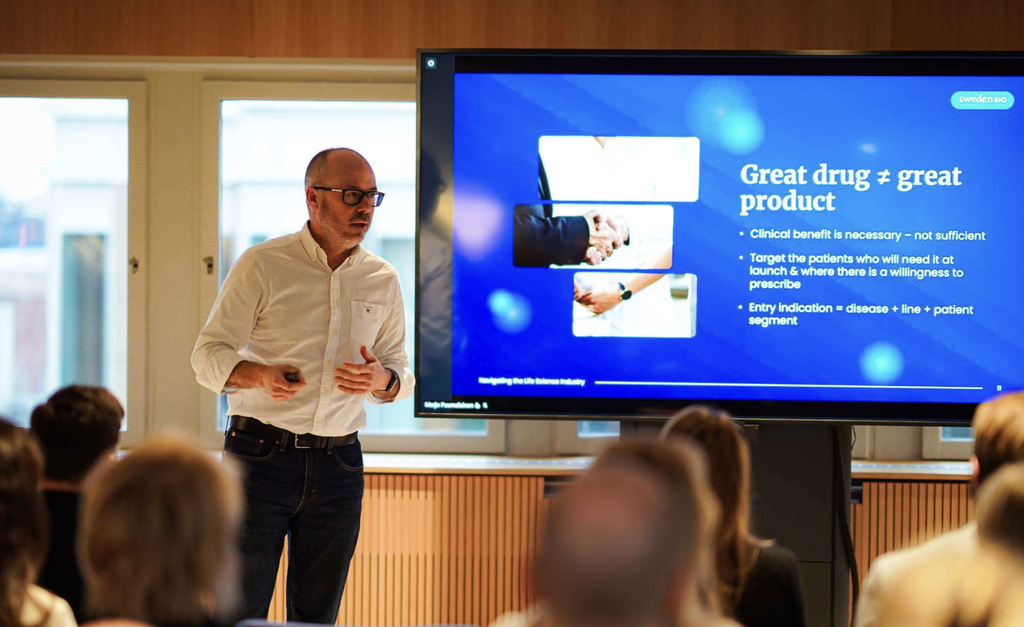
Jens Lindberg, CEO of Medivir, described how the company chose where to position its liver-specific cancer drug, which must be combined with a systemic therapy.
“Arguably, a great product in the wrong place is much worse than a lesser product in the right place,” he said. “A great drug isn’t necessarily a great product. Clinical benefit is super important, but it isn’t everything.”
Medivir continuously mapped late-stage clinical activity across treatment lines in liver cancer to predict what the future treatment landscape would look like. It saw large pharma companies crowding into first-line with immunotherapy combinations, so it chose to steer toward second-line treatment, where the unmet medical need was growing and competition was limited. To keep its options open, the company ran its phase 1b study in combination with both immunotherapy and a kinase inhibitor before committing.
“You can actually predict the future. It takes time and effort, but it can be done.” Lindberg said. That positioning has also strengthened the story told to investors: “We do have a great product, we believe, but we also have an awesome place to land, where the willingness to use is already high.”
“Clinical value does not automatically translate into commercial value”

Jimmie Hofman, Chief Business Officer of Vicore Pharma, used the company’s lead indication, idiopathic pulmonary fibrosis (IPF) as an example, to show how payer priorities differ between the US and Europe. The US accounts for the vast majority of the IPF market’s value, due in part to the pricing differential between the US and Europe. What drives price also differs: US payers mainly rely on lung function to determine value, while European payers put more weight on hard endpoints such as survival, and quality of life.
“The ability to get the highest possible price in Europe often depends on hard endpoints, whereas for US payers, lung function is typically sufficient,” he said. “That creates trade-offs that need to be considered. A European head-to-head trial powered for mortality would be much larger, longer, and more expensive than a typical pivotal trial in IPF, and every year of additional clinical development shortens the drug’s IP exclusivity.”
“If the majority of the market is in the US, your clinical development design and strategy will be heavily influenced by US considerations, while still enabling broad access,” Hofman said. “Maximizing global value may mean that in such a scenario, you wouldn’t aim to maximize price in every region.”
“If they don’t respond, it tells you something, you need to try harder and sell better”
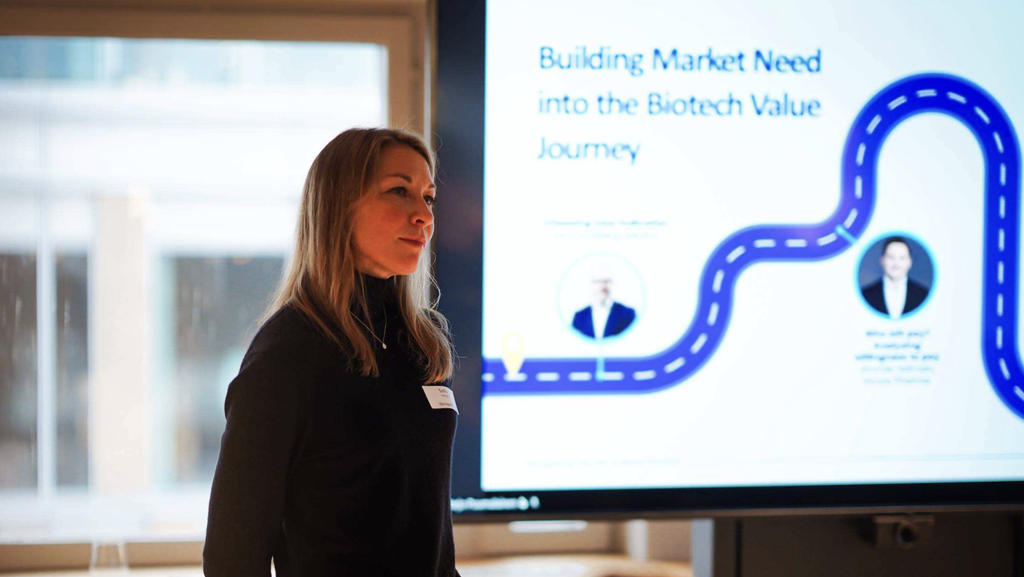
Sofia Heigis, CEO of Oncopeptides, focused on bringing external experts on board early. Oncopeptides have spent 26 years in hematology. When its preclinical data suggested the drug could cross the blood-brain barrier, the company decided to explore glioblastoma, a field where it had few contacts.
“It’s really important to have an external evaluation,” she said. “When you hit a challenge, and you will for sure at some point, you need external input and collaborators to support you” Her team mapped out the leading experts and emailed them. All of them replied within 24 hours, which she saw as a first sign of high unmet need. “If they don’t respond, it tells you something, you need to try harder and sell better,” Heigis said. “The responsiveness of your first contact indicate to you how hard this will be.”
The experts suggested a small clinical trial of around ten patients, costing less than SEK 10 million, to confirm that the drug actually reaches tumor cells in humans before larger investments are made. The trial ended up in Norway rather than Sweden, as swedish clinicians lacked experience with this type of study. An international steering committee consisting of key experts also support the company with input on their development program.
Experts matter when meeting regulators and payers too. Heigis pointed to Germany’s GBA regulatory body, where key opinion leaders give their view during benefit assessment hearings. “If they are not supporting you, you’re not getting a fair price,” she said. “This is not rocket science, but you need to invest time and resources, and you need the right people to work with key experts early on.”
